
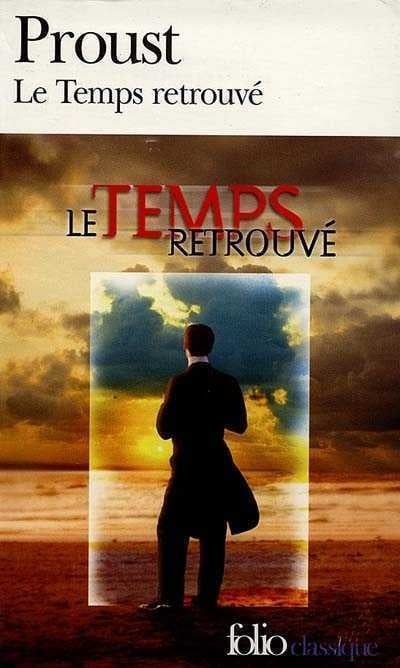
I have at last finished reading Proust’s signature work, A la recherche du temps perdu. I read it in French, because I read French well and I enjoy reading it, but also because, as I worked my way through the volumes, I came to suspect that Proust’s English translators have indulged in some kindly editing. The original text is laden with ornate, intentionally-convoluted sentences and heavily freighted with adjectives; it’s often repetitive, and sometimes just plain turgid. If you read it all the way through, and especially if you read it Proust’s original words, you may very well find it stylistically flawed. Yes, there are sentences of stunning, almost heart-melting beauty—now and then. But there is much writing that is as leaden as any academic expostulation on say, economics. The beautiful passages are indeed beautiful, but they are few, and they often occur in dialogue, when he is forced to write in a voice not his own. Dialogue is rare in the novel, but I reluctantly admit that those moments are worth the slog.
The heart of the story is its characterizations, uncharitable though they often are, as Proust could certainly be snide. A minor character that shows up in the first couple of volumes may return two thousand pages later, and you won’t have to stare up at a corner of the room with squinched eyes to remember who they are and what they mean; they’ll make perfect sense. This was in many ways Proust’s genius: making characters.
Unfortunately, the character at the heart of the story is, in many ways, an asshole.
Although M, Proust’s alter ego, is not given to violence except very rarely in his imagination, he expresses a litany of unsavory traits: he is a snob, a social climber, a tedious mansplainer, a gaslighter, a pathetically jealous control freak, a manipulator, and, when it comes to his work as a writer, one of the great procrastinators in the literary canons of this world, and possibly beyond. I doubt this can be explained solely by M’s nearly crippling asthma, which he shares with his author. The boundless affection and forebearance of his social milieu, which in this novel is largely the minor aristocracy of France, is also beyond my limited understanding. Yet I enjoyed the story, even as its tellers (both the fictional and the actual Marcels) irritated me to no end.
Especially in his treatment of Albertine, in the volume aptly titled La prisonniere. He keeps her in a room in the luxury flat where he lives with his mother, possibly his father (who is mentioned early in the story but then disappears without explanation), and their servant Françoise, whose lack of polish and formal grammar M mocks in asides to the reader. (One could write an entire dissertation-length analysis of his treatment of the Loyal Servant, but fear not: I won’t burden you with that.) But Albertine: kept at his beck-and-call in an adjacent bedroom, expected to provide affection and amusement on demand, and not allowed to go out except in the company of the family chauffeur or her best friend and involuntary chaperone Andrée, whom M has his eye on as a possible replacement. He prepares definitively to break up with Albertine repeatedly, but finally settles on a manipulation: he believes that simply by asking her to break up, this will inspire her to a closer and more desperate affection.
Instead, she actually leaves. M is flabbergasted, and enlists his friend Robert St. Loup to travel to her aunt’s house where she has gone and advocate for her return. Albertine won’t even talk with emissary, but does send M a nice and ambiguous letter. The matter is suddenly resolved when Albertine falls off a horse and dies. M’s reaction? In effect: “Oh, I’ll get over it, and there will be others.” A charmer, that boy, eh?
I will, unlike Proust, keep this concluding note short, as I have detailed both my pleasures and displeasures with this massive novel earlier: what I as a reader was waiting so long for was an epiphany, and Proust granted me not one (of course), but three….
During a phantasmagoric visit to a party after M has returned from an extended sojourn in a sanitarium, he sees his old associates, and realizes that they, and therefore he, are growing old. In the course of this party he somehow brings up three incidents of Zen-like modesty that suddenly tie him to his entire past life and make it coherent: he steps on a pair of uneven paving stones that bring him back to a moment in Venice (yes, he got there, and he didn’t write about it!); he handles a folded linen napkin that similarly calls up a memory from his youth; and—are you ready?—he stumbles onto another goddamn madeleine incident! And through these punktums he realizes that what he should write about is “what he knows”: his life, loves, and his endless burrowing into the aristocratic world. And so he finally commences his great work, which, as he has hinted now and then, is in the reader’s very hands right now.
He does not gain much in humility from these revelations, but he does go on to write his book.
And I went on to read it, and despite my complaints, I am glad I did.
Rick Risemberg
(To read the other articles in this series, click here.)
 Crow Tree Books